
Mini 5 Pro for Urban Coastline Surveying
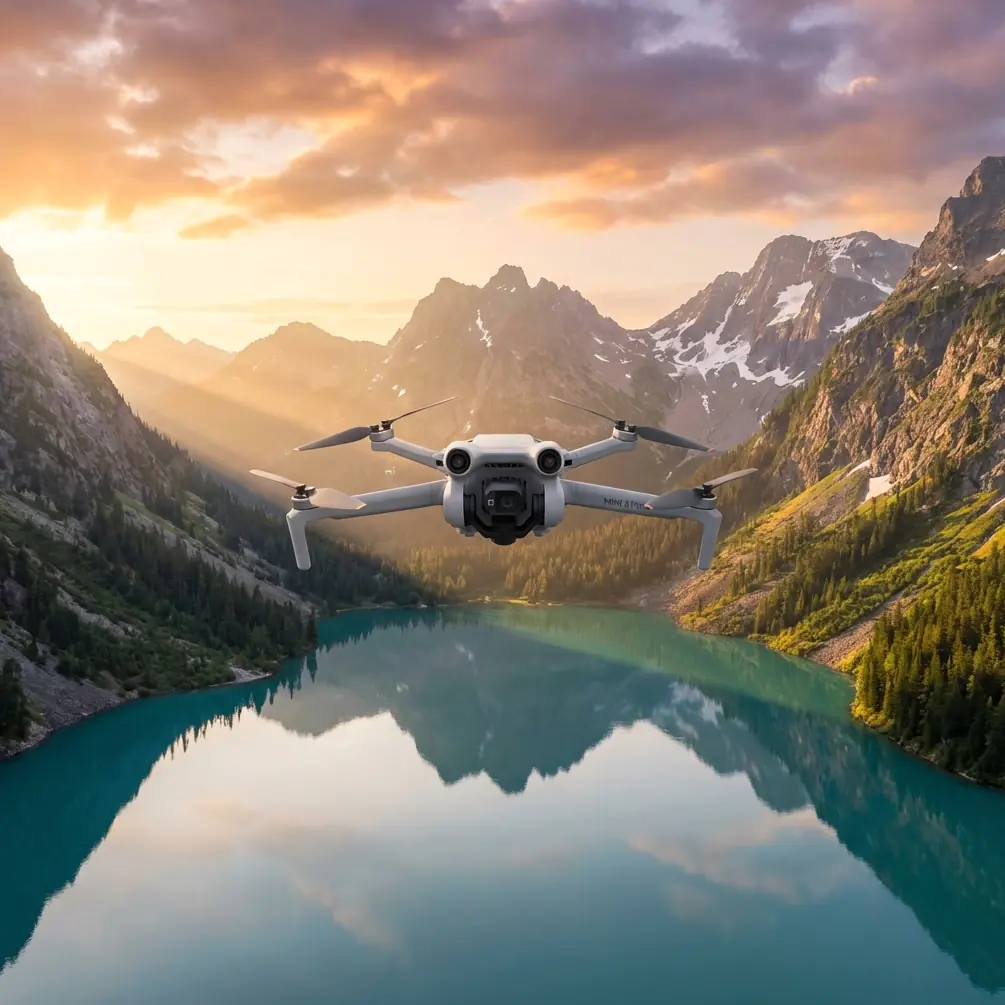
Mini 5 Pro for Urban Coastline Surveying: What the Workload Numbers Really Tell Us
META: A technical review of how Mini 5 Pro fits urban coastline surveying, using real photogrammetry workload benchmarks, efficiency comparisons, and field-ready operating logic.
Urban coastline surveying is rarely gentle work. You are dealing with reflective water, sea walls, mixed-height buildings, promenades full of people, intermittent wind, and narrow launch options that make larger airframes more trouble than help. That is exactly where the Mini 5 Pro becomes interesting—not because of marketing shorthand, but because the operational math behind drone photogrammetry already tells us what kind of platform wins in these conditions.
The most useful reference point here comes from a photogrammetry workload model for 10 square kilometers. It breaks down aerial survey production by mapping scale and compares drone workflows with conventional RTK plus total station methods. Those numbers matter more than spec-sheet chatter, because they expose where a compact aircraft like the Mini 5 Pro can actually create leverage for survey teams working along urban shorelines.
The real story is not “small drone versus big drone”
It is tempting to frame the Mini 5 Pro as a lightweight convenience tool. That misses the point.
For urban coastal jobs, the constraint is often not pure flight endurance. It is deployment friction. Survey crews need to move between short access points, avoid drawing too much attention in crowded public areas, and capture clean image sets between weather windows. A small, fast-to-launch aircraft can outperform bulkier systems simply by making more survey windows usable.
The reference dataset shows that for a 10 square kilometer UAV photogrammetry mission, the workload changes significantly depending on mapping scale:
- At 1:500, the workload includes 3 sorties, 3 days for control point measurement with 90 points, 3 days for aerial triangulation staffing, and a much longer downstream production phase that includes 40 days for stereo collection and 20 days for field mapping by one person.
- At 1:1000, that drops to 2 sorties, 50 control points, and 20 days for stereo collection.
- At 1:2000, it falls again to 1 sortie, 30 control points, and 15 days for stereo collection.
This is where the Mini 5 Pro should be judged: not as an isolated camera platform, but as the front-end acquisition node in a larger production chain. If your urban coastline project is targeting corridor mapping, shoreline change documentation, revetment inspection support, or municipal asset baselining at moderate map scales, the reduction from three sorties to two—or even one—changes staffing pressure, scheduling risk, and revisit economics.
Why those sortie counts matter on the coast
A “sortie” is not just a flight. On a coastal urban site it means travel to launch position, airspace checks, tide awareness, public safety management, battery staging, and usually at least some waiting for the light to stabilize. The difference between 3 sorties at 1:500 and 1 sortie at 1:2000 is not a mere planning detail. It changes whether the crew can finish before wind rises off the water, whether pedestrian density becomes a problem, and whether the same team can cover a second site that afternoon.
The Mini 5 Pro’s practical value grows in exactly that environment. A compact aircraft with obstacle awareness and reliable autonomous support features has a better chance of turning short, imperfect time slots into usable data collection periods. In urban waterfronts, that can mean launching from a narrow service lane behind a retaining wall, stepping around trees, lamp posts, moored vessels, railings, or rooftop parapets, and still maintaining clean overlap for photogrammetry.
During one seawall documentation run, a small flock of egrets lifted from the rocks just as the aircraft was transitioning laterally along a concrete embankment. That kind of moment is easy to dismiss until you are the pilot responsible for maintaining both safety and data continuity. In real operations, obstacle sensing is not just about avoiding buildings. It helps create the pause and reposition margin needed when wildlife unpredictably enters the flight path. On urban coastlines, birds are part of the environment. A platform that can detect, slow, and give the operator time to react is worth more than raw top speed.
The efficiency gap with RTK and total station is the key takeaway
The reference material states that UAV efficiency can exceed RTK plus total station by 6 to 8 times. That is the number every survey manager should sit with for a minute.
Traditional ground methods still have their place, especially for control, validation, and high-precision tie-in. But along urban coastlines, fully ground-based acquisition is punishing. You are walking uneven riprap, negotiating fences, tracing curved seawalls, moving around drainage outfalls, parked vehicles, and private frontage. Some portions are physically accessible but operationally inefficient. Others are technically visible but unsafe to occupy for long.
The same source indicates that a traditional RTK + total station approach could require 375 days for one team, with each team producing around 0.8 square kilometers per month and requiring at least two people. Even allowing for the roughness of summarized planning data, the contrast is obvious. Drone acquisition compresses front-end fieldwork so aggressively that the survey business itself changes. You are no longer tying up one crew on one waterfront job for months. You are freeing that crew for control, QA, and the next project.
For a Mini 5 Pro operator, this means the aircraft’s value is not measured only by image quality or flight smoothness. Its value is in helping a small survey unit behave like a larger one. Faster capture means more flexibility in tide cycles, more margin for weather, and more opportunities to revisit sections where shadows from towers or sea-facing buildings compromised the first pass.
Ground control is still where discipline lives
One detail in the reference set deserves more attention than it usually gets: the control point counts.
For 10 square kilometers at 1:500, the workflow calls for 90 control points measured over 3 days. At 1:1000, it drops to 50 points. At 1:2000, it becomes 30 points. That progression is operationally significant because urban coastlines are rarely geometrically forgiving. Long linear edges, repeated textures, reflective surfaces, and abrupt elevation changes can all weaken block stability if control design is lazy.
The Mini 5 Pro does not erase the need for solid survey fundamentals. If anything, a compact drone makes disciplined control strategy more important, because the ease of flying can tempt crews into thinking the aerial portion is the whole job. It is not. In shoreline mapping, control placement should account for:
- long narrow corridor geometry,
- transitions between open waterfront and dense urban frontage,
- changes in surface material,
- tidal exposure limits,
- and the need to anchor both ends and bends in the survey corridor.
If your deliverable is a municipal shoreline inventory or coastal infrastructure condition map, the biggest mistakes often come from weak field planning, not weak flying.
The Mini 5 Pro features that actually matter here
The context hints around obstacle avoidance, subject tracking, QuickShots, Hyperlapse, D-Log, and ActiveTrack are useful, but not all of them serve surveying equally.
For strict photogrammetry, the stars are obstacle awareness, stable path control, and image consistency. In an urban coast survey, obstacle avoidance helps with low-altitude transitions near vertical structures and gives an added buffer against cranes, sign poles, lamp columns, and roofline intrusions. It should never replace piloting judgment, but it can reduce interruption risk during repositioning legs.
D-Log deserves a place in this discussion too. Not because surveyors are chasing cinematic color, but because coastal scenes are contrast-heavy. Dark revetments, bright water glare, pale concrete, and shadowed stair structures can sit in the same frame. A flatter profile can preserve tonal information that helps with manual interpretation and visual condition review, especially when the same mission is expected to support both mapping and asset assessment.
ActiveTrack and subject tracking are not core photogrammetry tools, yet they can still be useful on the documentation side of a mixed mission. If the survey team also needs supplementary visual coverage of a shoreline maintenance vessel, floating boom alignment, or inspection walk along a waterfront edge, controlled tracking features can speed up ancillary capture without bringing a second aircraft. The mistake is using them as the survey method. The value is in using them for the supporting visual layer around the core mapping dataset.
QuickShots and Hyperlapse are less about measurement and more about communication. For consultants presenting to city planners, developers, or harbor stakeholders, a short hyperlapse showing tidal interface, pedestrian use patterns, or shoreline exposure across time can add context that orthomosaics alone cannot provide. That is not fluff. It is often what helps non-survey stakeholders understand why a retaining structure, drainage outlet, or erosion pocket matters.
Scale selection changes everything
The reference breakdown by 1:500, 1:1000, and 1:2000 is the best framework for deciding whether the Mini 5 Pro is the right tool for your urban coastline mission.
If the assignment demands fine-detail urban engineering output at 1:500, you are looking at heavier control requirements, more sorties, and a larger downstream processing load. The Mini 5 Pro can still be useful, but the operator needs a highly disciplined acquisition plan and a realistic view of post-processing labor.
At 1:1000, the balance often becomes more attractive for city shoreline inventory, corridor planning, embankment records, and land-water interface updates. Two sorties over 10 square kilometers is a manageable benchmark in many coastal districts if launch access and airspace permissions are well organized.
At 1:2000, where the source indicates 1 sortie and 30 control points for the same area, the case becomes even stronger for reconnaissance-grade mapping, broader coastal baseline work, or preliminary planning support. This is where a highly portable drone can move quickly enough to make repeat surveys practical, which is often the missing ingredient in shoreline management.
Labor savings are not abstract
The reference notes that for 10 square kilometers, labor savings can exceed 100,000 in local currency terms, and that 50 square kilometers can justify an entire UAV system. Even without dwelling on cost language, the operational implication is clear: once project volume reaches recurring municipal or developer-scale coastline work, drone acquisition stops being an experiment and becomes a capacity multiplier.
That is especially true in urban waterfront programs where repeatability matters more than one-off hero flights. Shoreline reinforcement checks, promenade expansion planning, drainage outlet inventory, waterfront façade context mapping, and change detection all benefit from a platform that can be redeployed quickly.
The Mini 5 Pro fits that pattern if the team treats it as a disciplined survey instrument first and a creative aerial device second.
A practical operating mindset for coastline crews
The smartest way to use the Mini 5 Pro on urban coastal work is to break the mission into two layers.
First, the measurement layer: planned overlap, conservative altitude, clean control, tide-aware timing, and minimal lighting inconsistency. This is the survey backbone.
Second, the interpretation layer: oblique passes for wall condition, D-Log footage for difficult contrast zones, and selected tracking or timed-motion shots for stakeholder communication. This is where the aircraft’s smarter imaging features pull extra value from the same field visit.
That dual-use model is why compact drones have become so hard to ignore in professional mapping environments. They do not replace every traditional workflow. They remove a huge amount of wasted motion around it.
If your team is comparing mission design options for waterfront mapping, reclamation edge review, or coastal asset documentation, it helps to discuss the workflow before buying into the wrong scale assumptions. A direct project chat often saves weeks of trial and error, and you can start one here: message a survey workflow specialist.
The Mini 5 Pro is at its best when the site is awkward, the survey window is short, and the client still expects clean deliverables. Urban coastlines check all three boxes. The reference workload numbers make the case plainly: fewer sorties, fewer control points at broader scales, dramatically higher field efficiency than all-ground methods, and a capture model that lets the rest of the survey pipeline move sooner.
That is not a theory. It is what the production math has been pointing toward all along.
Ready for your own Mini 5 Pro? Contact our team for expert consultation.