
Mini 5 Pro in Windy Vineyard Work: A Technical Review
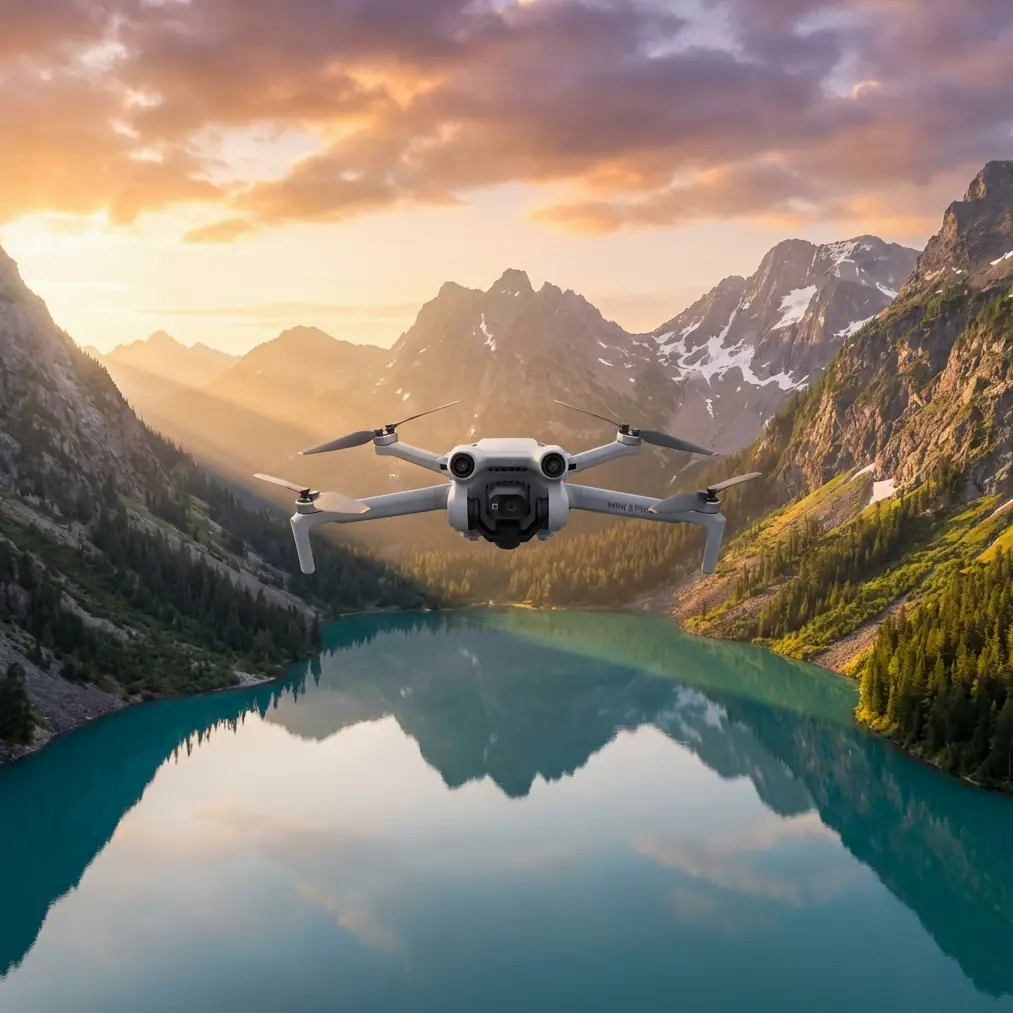
Mini 5 Pro in Windy Vineyard Work: A Technical Review of Stability, Sensing, and Signal Discipline
META: A technical review of the Mini 5 Pro for windy vineyard operations, covering obstacle avoidance, ActiveTrack, D-Log, Hyperlapse, and practical antenna adjustment under electromagnetic interference.
Wind changes everything in a vineyard.
Not just flight feel. Not just battery draw. It changes how a small drone reads the rows, how safely it works near trellis wire, how reliably it holds a link when metal infrastructure and farm equipment begin polluting the airspace with interference. If you are evaluating the Mini 5 Pro for vineyard-related operations in windy conditions, that is the real conversation: not whether the drone can get airborne, but whether it stays predictable when the environment becomes layered, reflective, and inconsistent.
I’m approaching this from the perspective of a photographer who also spends a lot of time thinking about operational discipline. That mix matters here. Vineyard work tends to sit at the intersection of image quality, route control, and risk management. You may be documenting vine health, checking row conditions after a weather event, creating progress visuals for a grower, or supporting planning around spray timing and canopy access. Even when the assignment is visually driven, the aircraft still has to perform like a field tool.
The Mini 5 Pro, viewed through that lens, becomes interesting for reasons that go beyond its size.
Why a sub-250-class style platform matters in vineyards
Vineyards compress space. You are often flying close to rows, posts, netting, perimeter trees, utility lines, and hillside contours. A larger airframe can offer more authority in wind, but a lighter platform brings its own advantage: it can be deployed quickly, repositioned easily, and used in narrower operating windows with less setup friction.
That does not mean wind stops being a limiting factor. Quite the opposite. In exposed vineyard blocks, especially on ridgelines or open valley edges, a light aircraft is constantly negotiating micro-gusts. One row may be calm while the next catches a lateral push. You feel that immediately during hover, but its real impact shows up in route consistency, image overlap, and obstacle margins.
This is where the Mini 5 Pro’s value is not a single headline feature. It is the stack: obstacle sensing, subject tracking, automated shot logic, and color tools like D-Log working together to reduce workload when conditions are less than friendly.
Wind is not the only threat. Trellis infrastructure complicates everything
People talk about obstacle avoidance in broad terms, but vineyards create a very specific challenge set. Trellis wires, end posts, irrigation hardware, anti-bird systems, and occasional reflective metal surfaces are not the same as flying around a building or a tree line. The obstacles are repetitive, thin, and sometimes difficult for any sensing system to interpret cleanly in changing light.
So when evaluating obstacle avoidance on the Mini 5 Pro, the operational significance is simple: it is not there to make a pilot careless. It is there to preserve margin when wind pushes the aircraft slightly off its intended line. In vineyard work, that margin can be the difference between a recoverable path correction and contact with infrastructure that is hard to see on-screen.
That matters even more during low-altitude inspection passes. A gust does not need to be dramatic. A small sideways drift toward a trellis row is enough to create a problem if the pilot is focused on camera framing or data capture. Good sensing buys reaction time. In practical use, reaction time is the currency that keeps field operations efficient.
ActiveTrack and subject tracking are more useful in agriculture-adjacent work than many assume
The common assumption is that ActiveTrack and subject tracking are mostly creative tools. In vineyard operations, they can be practical.
Think about following a utility cart moving along service lanes, documenting a worker team’s progress across a block, or capturing repeated movement patterns for operational review. In wind, manual tracking becomes harder because the pilot is managing both composition and aircraft position while also compensating for gusts. Subject tracking helps offload part of that task.
The significance is not “hands-free flying.” That phrase oversimplifies what competent operators do. The significance is workload reduction. In a windy vineyard, the pilot’s mental bandwidth is already being spent on drift, obstacle spacing, and signal quality. If the aircraft can maintain a more consistent lock on a moving subject while you supervise the route, the result is usually smoother footage and fewer abrupt stick corrections.
That same logic applies to QuickShots and Hyperlapse.
QuickShots and Hyperlapse are not gimmicks when used for vineyard documentation
A lot of pilots treat QuickShots as beginner features. In the wrong context, that’s fair. In structured agricultural environments, though, automated movement has real value because repeatability matters.
If you are documenting seasonal canopy growth, erosion patterns, drainage issues, or the visual impact of different management zones, repeated camera motions become useful. They create comparable visual records over time. A Hyperlapse from the same vantage point across multiple visits can reveal changes in labor activity, weather movement, or site logistics in a way still images often cannot.
QuickShots also have a place when a vineyard manager wants a clean, fast overview without spending half the morning setting up manual cinematic passes. The point is not flashy output. The point is operational efficiency. You can capture a stable orbit, pull-away, or reveal shot quickly, then move on to the more technical tasks.
In wind, automation can actually improve consistency if used intelligently. Manual flights often become jerky when the pilot fights the conditions too aggressively. A well-tuned automated move may deliver cleaner geometry, provided the operator leaves enough safety buffer around wires, posts, and edge vegetation.
D-Log gives the Mini 5 Pro a serious edge for inspection-grade visual work
D-Log is one of those features that sounds niche until you have to shoot a vineyard under punishing light.
Anyone who has worked rows at midday knows the problem. Bright sky, reflective leaves, deep shadows under the canopy, and uneven terrain all compete in the same frame. Standard profiles can clip highlights or crush shadow detail in exactly the areas you need to evaluate later. D-Log matters because it preserves more usable tonal information for post-processing.
The operational significance is not just prettier footage. It is better interpretability.
When you are reviewing row structure, canopy density, irrigation anomalies, or storm damage indicators, subtle tonal separation can help. If leaf texture disappears into a contrast-heavy image, you lose information. If bright sky forces the rest of the image down, you lose information again. D-Log creates more room to balance those extremes later.
For photographers and content teams working with growers, this is particularly valuable. A single flight may need to serve two audiences at once: the operations side that wants legible field detail, and the communications side that wants polished visuals. Having a flatter capture profile gives you flexibility for both.
The interference problem is real, and antenna adjustment is not optional
Let’s address the part many reviews skip: electromagnetic interference.
Vineyards are not empty fields. You may have nearby power infrastructure, pump systems, weather stations, metal equipment, service vehicles, wireless farm devices, and long runs of trellis wire acting as reflectors. Add a handheld controller in a compromised body position and your signal quality can degrade faster than expected, especially when the aircraft drops behind rows or changes aspect relative to the controller antennas.
This is where antenna adjustment becomes a practical skill, not a box-tick.
The mistake many operators make is pointing antenna tips directly at the aircraft. For most drone controller designs, that is not where the strongest propagation pattern sits. You usually want the flat faces of the antennas oriented toward the aircraft’s position, while also keeping your body, vehicle roof, or nearby metal structures from blocking the path. In a vineyard, even a few steps sideways can clean up a weak link if it gets you out of a reflective corridor or away from parked machinery.
Operationally, this matters because signal instability and wind compound each other. If the aircraft is already making constant micro-corrections in gusts, any lag or degraded transmission makes smooth control harder. You end up overcontrolling, which increases route deviation and battery consumption. Better antenna discipline reduces that chain reaction.
A few field habits help:
- Stand at a slight elevation when possible rather than deep between rows.
- Keep clear of tractors, trailers, and metal sheds during launch and recovery.
- Re-orient the controller as the drone moves laterally across blocks.
- If interference appears, change your body position before assuming the aircraft is at fault.
- Avoid flying low behind dense vegetation lines where both wind turbulence and signal obstruction can stack.
That may sound basic, but these basics are exactly what separate a calm mission from a frustrating one.
If you’re comparing setups or want to discuss a vineyard-specific flight workflow, this direct chat link is useful: message a field specialist here.
Can the Mini 5 Pro actually support windy vineyard spraying workflows?
This needs careful wording.
A compact imaging drone like the Mini 5 Pro is not the same thing as a dedicated agricultural spraying platform. For actual liquid application in vineyards, operators normally rely on purpose-built spraying systems with payload capacity, flow control, route automation, and safety structures designed for that task. A Mini-class aircraft is better understood as a support layer around the spraying workflow, not the spraying machine itself.
That distinction matters because it clarifies where the Mini 5 Pro genuinely fits.
In windy vineyard operations, the drone can be highly useful before and after spray windows. Before treatment, it can help assess row accessibility, canopy uniformity, drift-sensitive boundary zones, and weather-exposed sections of the block. After treatment, it can support visual checks, documentation, and communication back to the grower or operations manager. If wind is too strong for ideal spray timing, the Mini 5 Pro can still be valuable as a scouting and decision-support tool.
That is the smarter way to integrate it: as an aerial observer that helps make better field decisions, especially in sites where terrain and wind patterns shift from one parcel to another.
Handling in gusts: what matters most in practice
When a small drone flies in wind, pilots often focus on top speed and headline stability. Those matter, but they are only part of the equation. What you feel in real vineyard work is control coherence: how the aircraft transitions between hover, brake, climb, and lateral correction when the air is not stable.
For the Mini 5 Pro, the biggest test is whether it remains readable to the operator. Does it respond in a way that makes sense, or does it constantly feel like it is surprising you? In vineyard work, predictability beats aggressiveness. A drone that telegraphs its corrections clearly is easier to place safely near rows and easier to recover when a gust hits during a low pass.
Obstacle avoidance helps here, but so does disciplined mission design. Fly with more lateral offset than you think you need. Avoid threading narrow gaps when wind is active. Use higher altitudes for transits between blocks. Save low-angle beauty passes for calmer windows unless they are mission-critical.
That is not conservative flying for its own sake. It is how you keep the Mini 5 Pro useful instead of turning every sortie into a stress test.
Who this drone makes sense for
The Mini 5 Pro is best suited to vineyard owners, visual survey teams, content producers, consultants, and field managers who need a small aircraft that can document conditions quickly without the burden of a larger deployment. It is especially appealing when a single tool must cover several jobs in one visit: inspection visuals, progress footage, stakeholder updates, and repeatable automated clips.
Its strongest case in windy vineyard work comes from combination, not extremes. Obstacle avoidance supports safer operation around row infrastructure. ActiveTrack and subject tracking reduce pilot workload during moving documentation tasks. QuickShots and Hyperlapse improve repeatability for progress records. D-Log preserves more image data in harsh vineyard light. And antenna adjustment under electromagnetic interference can be the difference between a stable session and an unreliable one.
That last point deserves emphasis because it is often treated like an afterthought. It should not be. In a metal-rich agricultural environment, signal management is part of flying, not something separate from it.
The Mini 5 Pro will not replace larger specialty aircraft. It does not need to. Its role is narrower and, for many vineyard operators, more practical: get into the field quickly, gather clean visual information, stay controlled in imperfect conditions, and come home with files that are actually useful.
That is a far better benchmark than flashy marketing claims.
Ready for your own Mini 5 Pro? Contact our team for expert consultation.