
Mini 5 Pro in Windy Forests: A Practical Case Study
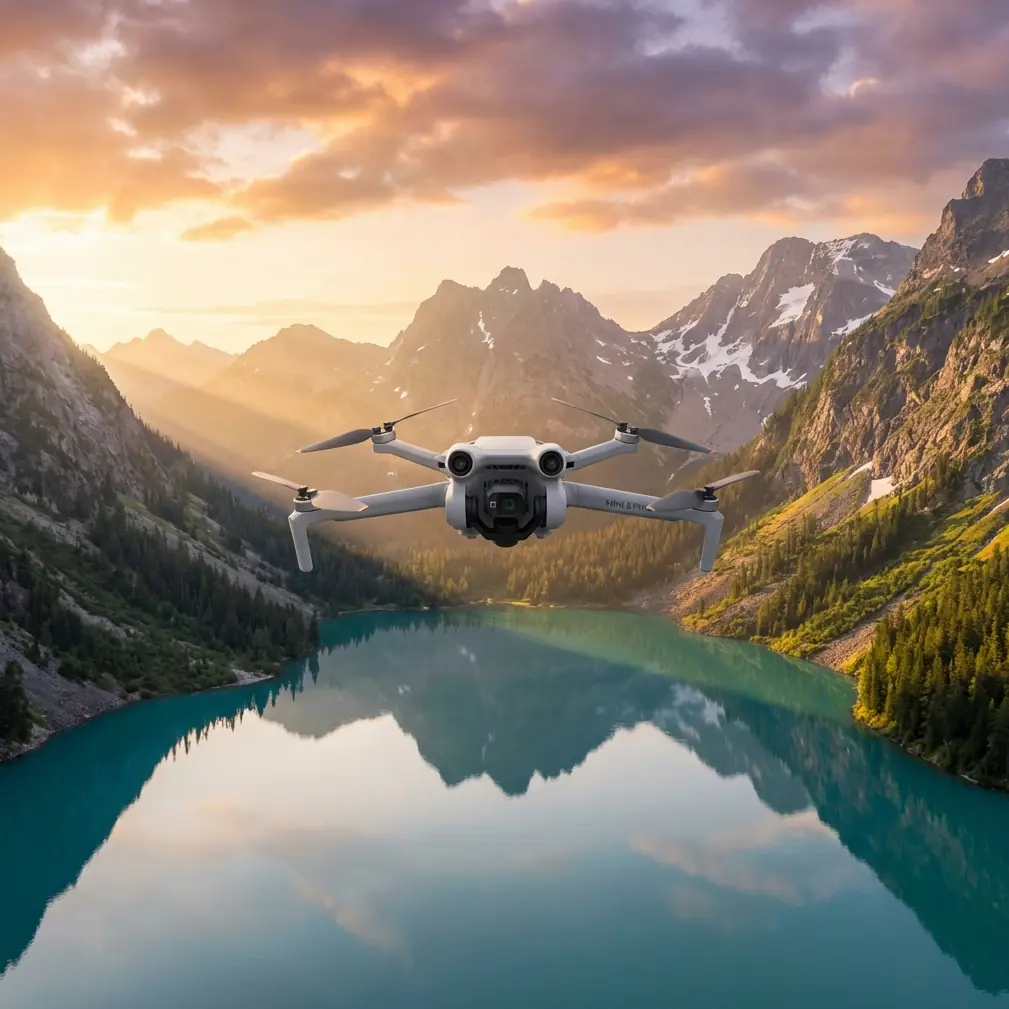
Mini 5 Pro in Windy Forests: A Practical Case Study on Range, Tracking, and Why Hybrid Power News Still Matters
META: A field-tested Mini 5 Pro forest filming case study covering windy conditions, antenna positioning, obstacle avoidance, ActiveTrack, D-Log workflow, and what new hybrid drone power developments could mean for the next generation.
Forests expose every weakness in a small camera drone.
Not on a spec sheet. In the air.
You feel it the moment the aircraft leaves the clearing and approaches the tree line. Wind stops behaving like a simple forecast number. GPS can remain strong while the image link turns erratic. Branches break up your line of sight. Gaps in the canopy create shifting highlights that confuse exposure. Tracking a moving subject suddenly becomes less about cinematic ambition and more about whether the drone can hold position, see obstacles early, and maintain a clean connection back to the pilot.
That is exactly why the Mini 5 Pro has become such an interesting platform for this kind of work. On paper, it sits in the compact end of the market. In the woods, though, what matters is not size alone. It is whether a lightweight aircraft can stay composed in turbulent air while giving the pilot enough confidence to fly deliberately rather than defensively.
I spent time thinking about that through a very specific scenario: filming in windy forest corridors where you want smooth movement, reliable subject tracking, and enough transmission stability to avoid turning every shot into a cautious retreat. This is less a glossy overview and more a working case study built around the operational realities of the Mini 5 Pro.
There is also a useful industry backdrop here. In April 2026, DroneLife reported that ePropelled expanded its Hercules starter generator line for hybrid propulsion and power systems, with products covering roughly 500 watts to 12 kilowatts. That is not Mini 5 Pro hardware. Not even close. But the significance is still real for anyone paying attention to where drone operations are heading. A power ecosystem scaling across hybrid uncrewed platforms tells us something important: endurance, energy management, and mission resilience remain front-and-center across the industry. For a compact aircraft like the Mini 5 Pro, that matters because every design choice in this class is still a negotiation between weight, endurance, stability, heat, and capability.
So let’s bring that back down from industry level to forest level.
The assignment: windy tree cover, moving subject, limited clean line of sight
The shooting brief sounds simple enough. Follow a runner along a forest path. Capture a few reveal shots over the canopy edge. Add a Hyperlapse segment to show cloud movement above the pines. Grab short QuickShots for social edits. Keep the image flexible in post with D-Log.
In open terrain, this is routine.
In a forest with inconsistent wind, it becomes a sequencing problem.
The Mini 5 Pro’s real value in this environment is not one marquee feature. It is how several systems stack together. Obstacle avoidance matters because the forest is full of thin vertical hazards and irregular branch intrusions. ActiveTrack matters because subjects disappear behind trunks, shadows, and sudden turns. Camera profile options such as D-Log matter because bright sky holes through the canopy can clip highlights while the trail itself falls into deep green-black shade.
And then there is range, which in forests is often misunderstood.
People talk about range as if it is a single maximum number. In the woods, that number means very little. What actually matters is transmission integrity through partial obstruction, body positioning, aircraft orientation, and where the controller antennas are pointed. The difference between a stable feed and a warning tone can be as small as a step to the left.
Antenna positioning advice that actually helps in the woods
If you only change one habit when flying the Mini 5 Pro in forests, change this one: stop aiming the tips of the controller antennas at the aircraft.
That is one of the most common mistakes I see, especially with newer pilots who assume the antenna works like a flashlight beam. In reality, the strongest part of the signal pattern is typically broadside to the antenna surfaces, not off the point. For practical field use, you want the flat face or side of the antenna orientation presented toward the drone, not the narrow end.
Why does this matter so much in a forest?
Because trees already weaken and scatter signal. If you also misalign your antennas, you are compounding attenuation with poor controller geometry. In open air, you may get away with it. Under canopy edges or through a corridor of trunks, the penalty becomes obvious.
My field routine with the Mini 5 Pro is simple:
- Stand where I maintain the cleanest possible visual corridor, even if that means moving a few meters before takeoff.
- Hold the controller at chest height, not down near the stomach.
- Rotate my body instead of just twisting my wrists.
- Keep the broad side of the antennas oriented toward the aircraft’s likely flight path.
- Reposition early if the subject route will force the drone behind dense tree clusters.
That last point matters more than pilots expect. Range problems in forests are often pilot-position problems. If you know the runner, cyclist, or hiker will disappear behind a stand of firs in twenty seconds, don’t wait for the signal warning. Move while the link is still clean.
If you need a second opinion on setup details before a forest shoot, this quick WhatsApp line for Mini 5 Pro planning is useful to have on hand.
Why obstacle avoidance changes your shot choices
A lot of pilots talk about obstacle avoidance as insurance. In forests, it is also a creative enabler.
Without it, you tend to fly higher, wider, and more conservatively. Your compositions become generic because you are mentally budgeting space for mistakes. Once you trust the sensing system, you can work closer to the path, hold lower altitudes, and explore more dynamic parallax through tree spacing.
That does not mean surrendering control to automation. It means using obstacle avoidance to expand the safe envelope for planned movement.
The Mini 5 Pro becomes especially useful when the wind is gusting laterally through breaks in the trees. In that condition, the aircraft may need frequent micro-corrections just to preserve line and heading. A drone that can see and react to nearby obstacles gives the pilot more room to focus on framing and subject timing rather than manually protecting every meter of flight.
Operationally, the significance is straightforward: obstacle sensing buys mental bandwidth. In a forest, mental bandwidth is precious.
ActiveTrack in a forest is really a test of discipline
Subject tracking sounds perfect for trail work until the first sharp turn under mixed lighting.
The Mini 5 Pro can be very effective here, but only if you use ActiveTrack with realistic expectations. Dense backgrounds, alternating light patches, and repeated occlusions are a harder tracking environment than open beach or road scenes. Trees create visual noise. Shadows change shape as the wind moves the canopy. A subject wearing earth tones can blend into the frame in ways people do not notice until the drone starts hesitating.
The solution is not to avoid ActiveTrack. It is to stage for it.
I have had the best results by starting the track in a cleaner section of trail where the subject is well separated from the background. Let the system identify the subject clearly before entering denser sections. Then keep speed modest enough that the aircraft is not constantly trying to recover from aggressive directional changes. In windy forest work, smooth and readable beats fast and dramatic almost every time.
This is where the Mini 5 Pro’s compact form helps. A smaller drone is less intimidating around runners and hikers, which often leads to more natural movement from the subject. They are less likely to overperform for the camera. That translates into footage that feels observed rather than staged.
QuickShots and Hyperlapse are useful here, but not in the obvious way
QuickShots are often dismissed as beginner features. That misses the point.
In a windy forest setting, QuickShots can work as reconnaissance for repeatable camera paths. A pre-structured movement helps you assess how the aircraft behaves near tree spacing, how the wind affects arc smoothness, and whether your chosen clearing gives enough room for the move. Even if the first clip is not the keeper, it can reveal the safe geometry for a manually refined second take.
Hyperlapse is even more situational. Forests can make Hyperlapse footage look messy if the frame contains too many close branches moving unpredictably. But at the edge of the canopy, looking out over treetops and shifting weather, the feature becomes more compelling. Wind-driven cloud movement paired with subtle tree motion can create a strong sense of atmosphere, especially when the aircraft holds a stable position against changing gusts.
That stability is the hidden story in almost every good forest Hyperlapse. If the drone cannot maintain composure, the sequence falls apart.
D-Log is not just for colorists
D-Log matters in forests because woodland contrast is deceptive.
A normal profile may look pleasing on the controller screen, but once you start editing, you discover the compromise: bright sky detail is gone, while the greens in the shadows have already collapsed into muddy blocks. D-Log gives you more room to balance those extremes. That is not about making the footage “cinematic” in a vague sense. It is about preserving information in a scene that naturally wants to exceed the comfort zone of small-camera dynamic range.
For Mini 5 Pro pilots filming forests, the workflow implication is simple. If the light is changing quickly and the canopy has strong gaps to the sky, D-Log provides insurance you will appreciate later. You can recover a more natural tonal separation between trail, bark, foliage, and cloud without forcing everything into an overly contrasty look.
What the hybrid power news tells us, even for a small drone pilot
At first glance, the DroneLife report on ePropelled’s Hercules line seems unrelated to a Mini 5 Pro forest shoot. The company’s 2026 expansion focused on hybrid propulsion and power systems for uncrewed aerial, ground, and marine platforms, with a broad 500 W to 12 kW span. That sits in a very different class from a compact folding camera drone.
But the operational significance is worth attention.
First, it confirms where engineering effort is going across the wider UAV market: more flexible power architectures, longer missions, and systems designed around energy efficiency rather than just peak output. That matters because even if the Mini 5 Pro remains a battery-powered aircraft, the expectations shaping future drone design are being influenced by exactly these pressures.
Second, it reinforces a truth every forest pilot already knows in practice. Endurance is not just a battery number. It is how long a drone can produce useful work while dealing with wind, maneuvering demands, sensor load, and transmission constraints. Hybrid systems attack that challenge at larger scales. Compact drones attack it through ruthless efficiency. Different solutions, same operational problem.
That is why small-drone pilots should still watch power-system developments outside their own category. The technologies may not transfer directly, but the mission priorities often do.
The field takeaway: fly the forest, not the brochure
When people ask whether the Mini 5 Pro is a good drone for filming forests in windy conditions, I think the better question is this: can the pilot use its strengths in the right order?
If you launch and immediately chase dramatic motion, the forest will humble you. If you treat the location like a living signal obstacle course and build your flight from the ground up, the aircraft starts to show its value.
Pick your pilot position with transmission in mind. Orient the antennas correctly. Use obstacle avoidance to lower risk while preserving creative options. Start ActiveTrack where the subject is visually clean. Use QuickShots to understand space, not just generate clips. Save D-Log for lighting conditions that truly need flexibility. Work with the wind instead of trying to overpower every gust.
That is what separates usable footage from frustrating footage.
The Mini 5 Pro is not interesting because it promises everything. It is interesting because, in a difficult environment like a windy forest, its practical tools can work together in ways that reduce pilot workload and improve shot consistency. And in drone work, consistency is often the difference between a fun flight and a deliverable one.
Ready for your own Mini 5 Pro? Contact our team for expert consultation.