
Mini 5 Pro in Thin Air: A Field Report on Capturing High
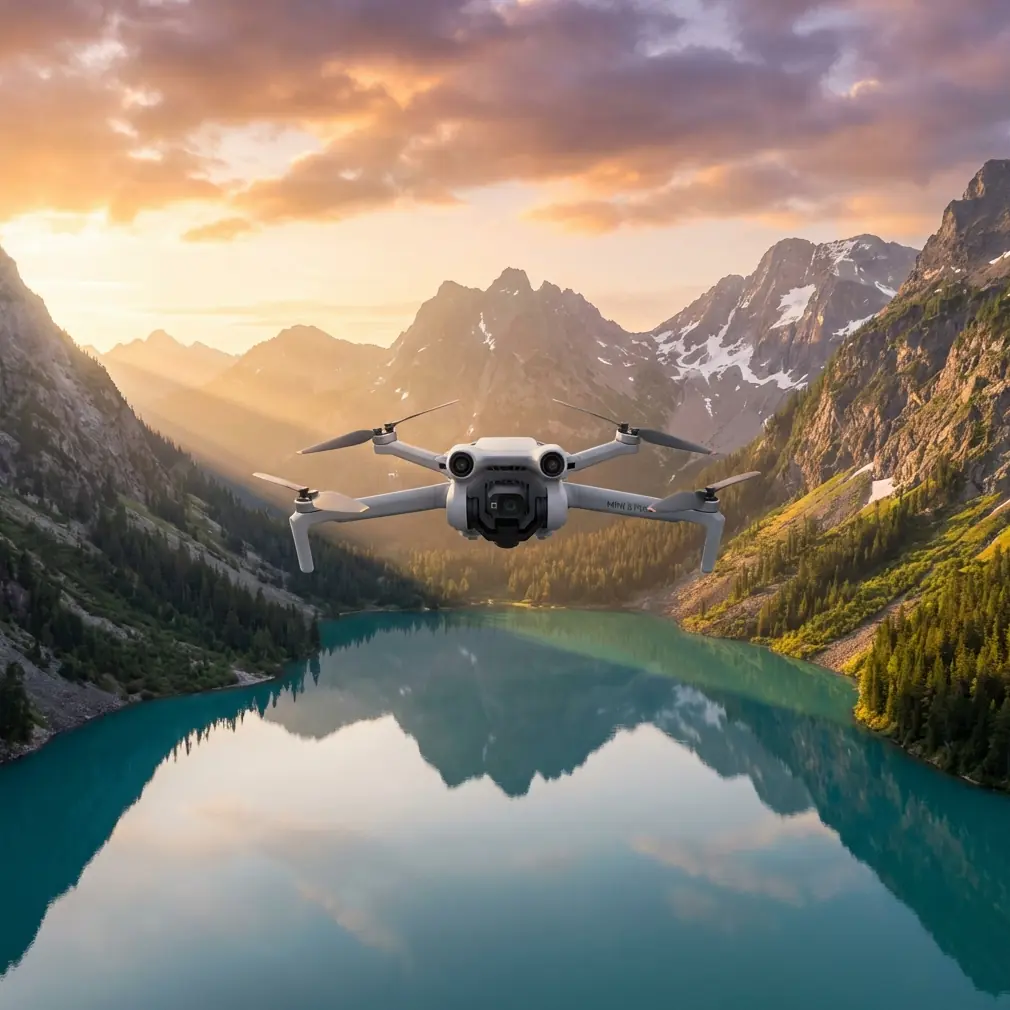
Mini 5 Pro in Thin Air: A Field Report on Capturing High-Altitude Solar Farms When Weather Starts Painting the Landscape
META: Field report on using the Mini 5 Pro for high-altitude solar farm filming, with practical altitude strategy, cloud-layer timing, obstacle avoidance, tracking, D-Log workflow, and lessons drawn from rain-driven cloud sea conditions like those seen over Kongtong Mountain.
By Chris Park
High-altitude flying has a way of exposing weak planning fast. Air gets thinner. Wind behaves less politely. Light changes by the minute. And if your assignment involves a solar farm spread across elevated terrain, the problem is not simply getting the drone airborne. The real task is building a shot plan that preserves scale, panel geometry, and terrain context without letting haze, low cloud, or uneven relief flatten the story.
That is why a recent aerial scene from Kongtong Mountain in Pingliang, Gansu caught my attention. During the National Day holiday period, the area saw continuous rainfall, and the weather produced streaming clouds and a sea-of-clouds effect. Mountain ridges and historic buildings appeared and disappeared inside the mist. Kongtong Mountain is a national 5A scenic area, but from an operator’s perspective, the tourism label is less relevant than what the weather revealed: rain-fed moisture can turn a familiar landscape into a layered, shifting surface where visibility, contrast, and subject separation change in seconds.
For anyone flying a Mini 5 Pro over high-altitude solar infrastructure, that matters more than it may seem.
A solar farm is not a temple roof in cloud. But both are large landscape subjects whose visual meaning depends on partial concealment, edge definition, and the relationship between man-made geometry and natural terrain. The Kongtong footage reminds us that after sustained rain, the atmosphere can become part of the composition rather than just a condition to endure. If you know how to work that layer, the Mini 5 Pro becomes far more than a simple overview camera.
What the Kongtong weather pattern teaches a solar farm operator
The key detail from the Kongtong scene is not just that it rained. It is that continuous rainfall created flowing cloud and cloud-sea conditions, with mountain forms and architecture intermittently obscured. Operationally, that tells us two things.
First, moisture after rain often creates vertical scene separation. In high-altitude solar filming, this can help you isolate panel arrays from distant ridgelines, making the site read more clearly on camera. Instead of a busy background, you may get a soft atmospheric layer behind the installation.
Second, intermittent concealment changes how you should choose flight altitude. If you climb too high, the cloud layer can swallow your scene. If you stay too low, you may lose the larger pattern of the array and the way it sits on the mountain shoulder or plateau. The best altitude is rarely the legal maximum or the lowest safe pass. It is usually the level where the panel field remains fully legible while the background starts to simplify.
That is the core altitude insight for this scenario.
My preferred altitude logic for high-altitude solar farms
When I am filming solar infrastructure in elevated terrain, I do not start by asking, “How high can I go?” I ask, “At what height does the project become readable?”
For most high-altitude solar farms, the sweet spot for primary establishing shots is often a moderate altitude above the installation rather than a dramatic climb. In practice, I look for a level where three things happen at once:
- the rows of panels separate cleanly
- maintenance roads or inverter stations give scale
- the terrain contour is still visible enough to explain why the site is there
If you push much higher, panel rows can merge into a dull texture, especially under hazy post-rain light. If you stay too low, the footage becomes about equipment detail rather than site intelligence.
In cloud-active mountain weather like the kind seen over Kongtong Mountain after continuous rain, I usually build the sequence around three altitude bands:
1. Low reveal band
This is for surface texture and operational intimacy. Use it to show panel alignment, slope angle, drainage conditions, and service paths. The footage works best when the cloud ceiling is low and moving, because the shifting background gives the installation depth.
2. Mid-altitude narrative band
This is usually the money zone. It shows the solar farm as infrastructure embedded in terrain. If the weather has generated flowing cloud, this altitude often keeps the array below the mist line while letting the hills behind drift in and out. That visual relationship tells the story of remote placement better than a top-down map view ever will.
3. High context band
Use this sparingly. In high-altitude environments, especially after rain, visibility can collapse quickly as you climb. Take the shot, confirm the geometry, then come back down. Too much time here and you risk flat, low-contrast footage with weak subject separation.
The operator mistake I see most often is overcommitting to the highest band. Bigger is not always clearer.
Why obstacle avoidance matters more in mountain solar work than people assume
Solar farms look open from a distance, but the approach environment often is not. High-altitude sites can include rising ridgelines, abrupt terrain transitions, cable runs, small utility structures, weather masts, and service vehicles moving unpredictably. Add post-rain mist and the risk profile changes.
This is where obstacle avoidance on the Mini 5 Pro becomes less of a brochure feature and more of a risk management tool. In clear weather over flat ground, some pilots treat automated sensing as a backup. In broken mountain visibility, it becomes part of the shot design. If I am flying a lateral reveal with low cloud moving across the site, obstacle sensing gives me more confidence to hold a consistent cinematic line instead of overcorrecting every second.
That operational significance is easy to miss. Good obstacle avoidance does not just help prevent contact. It protects shot smoothness when the visual environment is unstable.
ActiveTrack and subject tracking on a solar site: useful, but not in the obvious way
A solar farm is not a cyclist or a vehicle commercial. So why mention ActiveTrack or subject tracking at all?
Because the subject does not always have to be the entire site.
On inspection-style shoots, I often use tracking functions to follow a maintenance vehicle along service roads, or to hold a technician group in frame while the panel field dominates the background. That gives the audience a scale reference instantly. Huge arrays become understandable when a human workflow sits inside them.
In weather patterns like those observed at Kongtong Mountain, where cloud and mist make static scenes feel ethereal, a moving subject becomes even more valuable. The contrast between a stable panel field, flowing cloud, and a tracked maintenance vehicle creates a layered image that feels alive without becoming chaotic.
The trick is restraint. Let ActiveTrack support the narrative, not define it.
QuickShots and Hyperlapse are not gimmicks if you assign them a job
Most professional operators dismiss preset motion modes until a client suddenly wants social edits, progress reels, or fast-turn site updates. Then those same tools save time.
For a high-altitude solar farm, QuickShots can be useful when you need repeatable motion around a substation edge, inverter block, or ridge-adjacent section of panels. The value is consistency. If the weather window is short, repeatability matters.
Hyperlapse is where things get interesting in post-rain mountain conditions. Remember the Kongtong example: continuous rainfall led to streaming clouds and scenes where buildings and peaks faded in and out of the cloud sea. That same atmospheric behavior over a high-altitude energy site can produce excellent time-compressed sequences. Clouds sliding across an array show weather exposure, terrain flow, and the scale of the installation in a way a normal-speed clip cannot.
Used well, Hyperlapse can show how a mountain site breathes.
D-Log is your insurance policy when cloud and reflective panels collide
Solar farms are hard on exposure. You have dark terrain, bright sky, reflective glass, metal framing, and often a shifting veil of moisture that changes local contrast minute by minute. If the light is unstable, standard profiles can clip highlights on the panels or crush the mountain side into mush.
This is where D-Log earns its keep.
In high-altitude conditions, especially after rain, sunlight can burst through cloud breaks and create extreme transitions across the frame. Recording in D-Log gives you more room to recover panel detail while preserving the tonal separation in cloud layers. That matters because your footage is not just about a power asset. It is about where that asset lives. If the sky turns into a blank white sheet or the distant ridge disappears into gray sludge, you lose half the story.
A good grade should keep the panel lines clean, hold cloud texture, and preserve enough color distinction between wet ground, vegetation, and built surfaces to make the terrain readable.
Flight timing: the best window is often after the weather, not before it
The Kongtong sequence came after a period of continuous rain, and that timing is the lesson. Many operators assume the perfect day is clear from dawn to dusk. For mountain work, that can be visually boring. The strongest footage often comes in the recovery period after precipitation, when the cloud structure starts breaking and reforming.
For high-altitude solar farms, my favorite windows are:
- shortly after rain ends, when residual moisture is still shaping the background
- early morning, when the cloud layer sits low and site geometry emerges gradually
- late afternoon if the sun angle helps panel rows read without excessive glare
What I avoid is chasing dramatic clouds without a visibility plan. Atmospheric footage only works when the infrastructure remains intelligible.
A practical shot sequence for this scenario
If I were sending a Mini 5 Pro to document a high-altitude solar farm under weather conditions inspired by the Kongtong Mountain scene, the sequence would look like this:
Start low and slightly offset from the panel rows. Let the first shot establish texture, moisture, and incline.
Move to a mid-altitude lateral slide. This is where the site becomes a system, not just a collection of panels.
Add one controlled climb to test the cloud boundary. If the upper terrain begins dissolving into haze, stop there. Do not keep climbing just because the drone can.
Track a maintenance vehicle or technician movement with ActiveTrack for a scale pass.
Capture one Hyperlapse of cloud drift over the array if the weather is moving cleanly.
Finish with a static or slow-push D-Log shot facing the broadest section of the farm, preserving room for grading.
That sequence gives you texture, context, atmosphere, operational scale, and editorial flexibility.
One last point on high-altitude discipline
Thin-air sites tempt operators into dramatic flying. Resist that impulse. The best high-altitude solar footage is usually calm, measured, and deliberate. Let the environment create the drama. Your job is to choose the altitude where the site still reads and the weather starts doing visual work for you.
The Kongtong Mountain aerials are a strong reminder of what rain can add to a scene: flowing cloud, cloud sea, and subjects that appear and recede rather than simply sit under a blue sky. Applied to solar farm work, that means the Mini 5 Pro should not just be flown over the site. It should be positioned in relation to the moisture layer, the terrain contour, and the reflective behavior of the panels.
Get that right, and even a difficult mountain energy project can look clear, elegant, and truthful on screen.
If you are planning a similar workflow and want to compare flight profiles or camera setup choices, send the site details here: https://wa.me/85255379740
Ready for your own Mini 5 Pro? Contact our team for expert consultation.